
T-Trak - Urban Town Scenic Endcap Module
 MeddieMakes (Craig)Started 4 August 2026
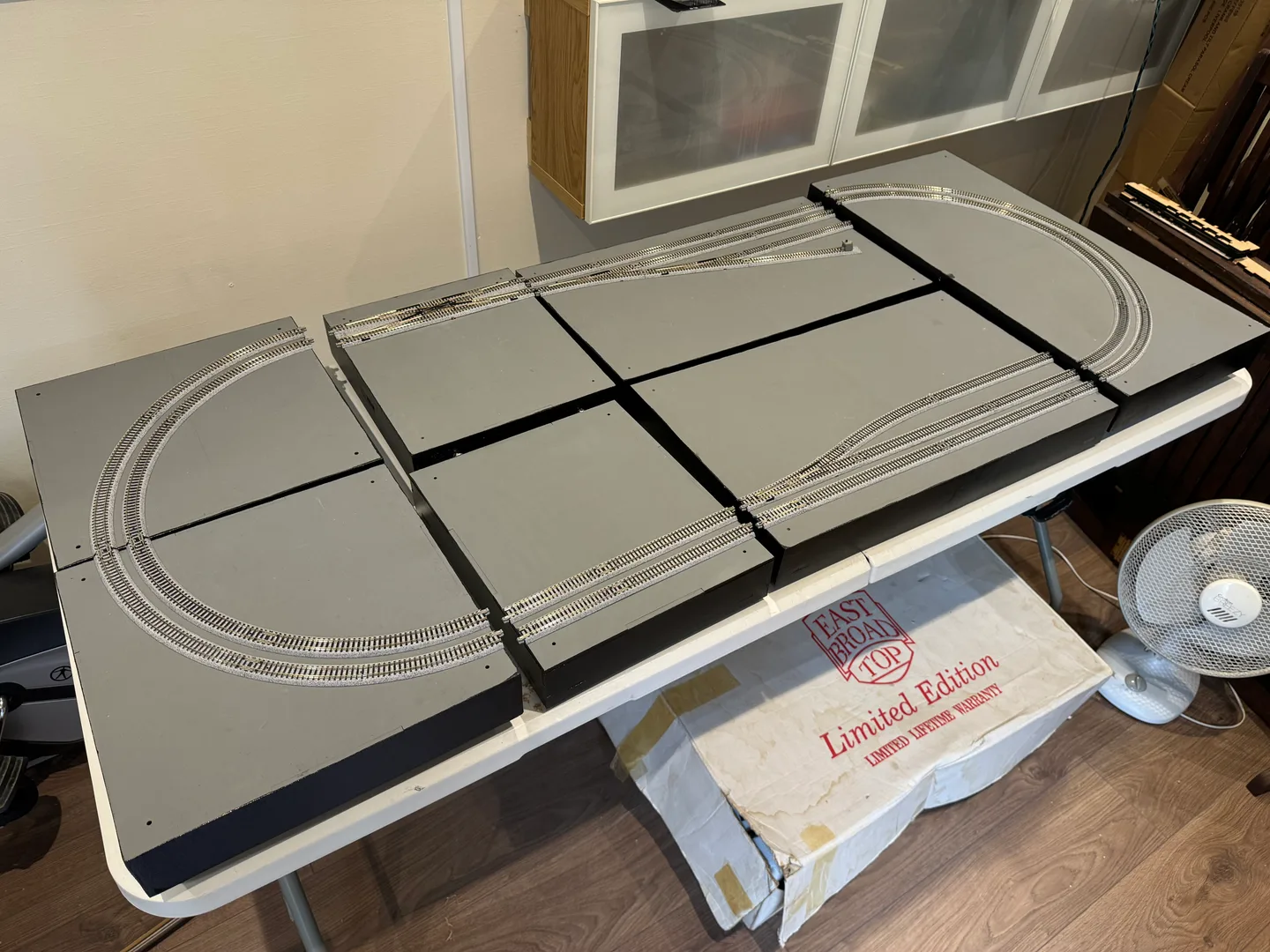
Welcome to the very first build blog post for my new N gauge T-Trak Exhibition layout project! The inspiration for this build comes directly from YouTube modeller Emperor's Path and his 2025 exhibition layout "Emperor's Pathway." While his layout was built in OO gauge, I was fascinated by the concept of creating an immediate, self-contained exhibition piece on a tight footprint using continuous-running loops. The goal of this module is to construct a heavily weathered, multi-level modern British urban scene (2015+ era) on a standard T-Trak Endcap module using one of my T-Trak kits. Initially this module will act as standalone run around exhibition layout but the plan it to expand this module with further modules to create an ever expanding layout that can be adapted to space or venues as the number of modules expands.
Update 1: Baseboard Assembly & Track Installation
1 : Baseboard Assembly
A successful modular layout relies entirely on a flat, square, and dimensionally stable base. For this build, I assembled a standard T-Trak Endcap baseboard kit made from 6mm laser-cut birch plywood with internal bracing.
Key Specification Check: T-Trak standards rely on standardized levelling legs and tight outer dimension tolerances. The baseboard are designed to placed on standard 6ft event table. The track bed is designed to be 70mm above the table surface before levelling bolt adjustments allow for adjustment up to 100mm.
The MDF T-Trak kits were dry-fitted first to check squareness across all diagonal measurements. Wood glue (PVA) was applied to all interlocking finger joints and clamped firmly. Once cured, four adjustable M6 levelling feet were installed into the corner blocks. These allow precise height alignment (+/- 30mm) when connecting to other modules at future exhibitions.
Finally before moving on to installing the Kato Unitrack. I decided to paint the modules to make them more presentable and also offer addition protection to the MDF from moisture.
2: Kato Unitrack Positioning & Interface Tolerances
The module utilizes Kato N Gauge Unitrack double-track curves. Because this is an endcap, the track forms a full 180-degree return loop, transitioning from standard T-Trak double-track spacing at the module interface into the curved return.
Track Components and T-Trak Standards
Outer loop Radius: R315mm (12.4") 45° Curves (Kato 20-120)
Inner look Radius: R282mm (11.1") 45° Curves (Kato 20-110)
Interface Overhang: 1.0mm overhang, Crucial for Unijoiner connection between T-Trak modules
Power Feeds: Kato Terminal Unijoiners (Kato 24-818)
Crucial T-Trak Rule: When position-marking the Kato track at the module joiner edge, the track plastic roadbed must extend 1.0mm past the wooden edge of the baseboard. This overhang enables the Kato Unijoiners to slide firmly into adjoining modules without binding or leaving open rail gaps.
To initially fix the track to the baseboard, I use the pre cut mounting holes that are provided to a fix M2 6mm self tapping screws to the underside of the Unitrack. Later when I ballast the track, the ballast and scenic glue will help add addition adhesion for the track.
While installing the track, I add the power feeds into the baseboard. As I will be adding occupancy detection at a later date, I split each radius into 2 sections, 45° and 135°. This will be explained more in a future update.
After installing the track, I decided to add a 2.5mm layer of XPS foam to the surface of the module, as I find the 5mm should of the Unitrack to little tall and this also allow me to reduce the amount of ballast and ground scatter reducing cost and weight.
Build Stats
Layout Specifications
Linked Layout
MeddieMakes - Unnamed T-Trak Module Layout
N (1:160)
Comments (0)
Community Guidelines
Keep all comments friendly. Feedback should be constructive and no derogatory comments are tolerated.
Sign in to join the conversation
No comments yet
Be the first to share your thoughts!