
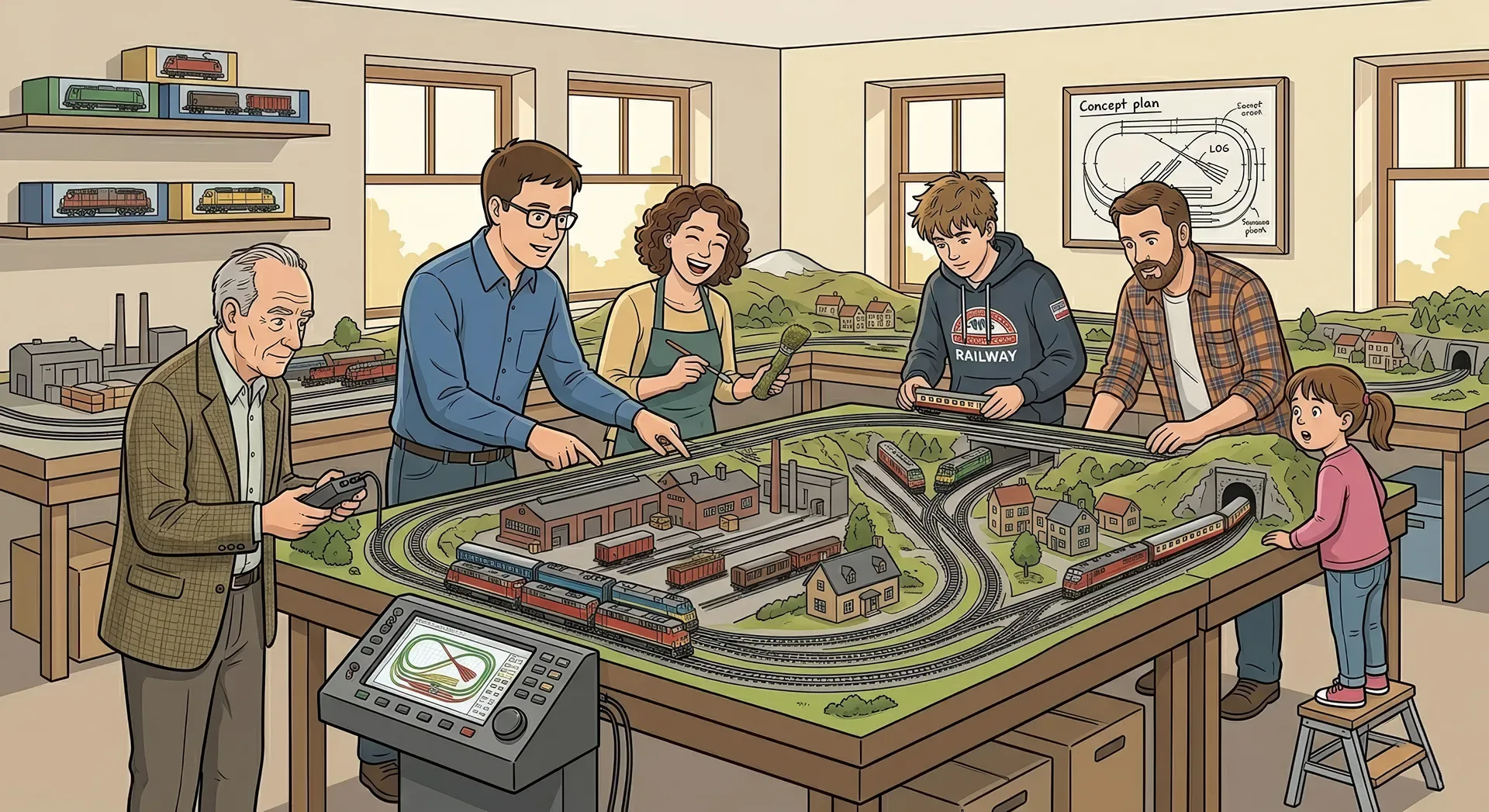
Best Model Railway Communities to Join

A well-built station canopy, neatly ballasted track, a convincing goods yard - model railways reward detail, patience and a fair bit of problem-solving. That is exactly why the best model railway communities matter so much. This is a hobby where progress often comes from seeing how someone else solved a wiring issue, staged a rural scene or made a small spare-room layout feel like a full railway world.
Not all communities serve the hobby in the same way, though. Some are great for fast inspiration. Others are better for deep technical advice, long-running build logs or local club connections. The right choice depends on what you want from the hobby at this stage - applause for a finished layout, honest critique on a station throat, or steady encouragement while you rebuild the same corner for the third time.
What makes the best model railway communities worth your time
A good community does more than collect photos. It gives your work context. When fellow enthusiasts can recognise the difference between clean OO branch line modelling and a tightly planned N gauge urban layout, feedback becomes far more useful. You are not explaining the basics to a general audience. You are speaking to people who understand why point alignment, era consistency and scenic transitions matter.
The best spaces also make discovery easy. If you can browse layouts by gauge, theme, region or build stage, you spend less time searching and more time finding ideas you can actually use. That matters whether you are laying your first oval or refining signalling on a mature layout.
Community culture matters just as much as features. A platform can have galleries, ratings and comments, but if the tone is snide or overly competitive, people stop sharing. The strongest communities tend to balance pride with generosity. Members want recognition, yes, but they also want to help others improve.
The main types of model railway communities
Dedicated model railway platforms
These are often the best fit for hobbyists who want relevant feedback and easy discovery. Because the whole platform is built around model railways, categories tend to make sense straight away - layouts, build logs, track plans, gauges and scenery. That sounds simple, but it removes a lot of friction.
A dedicated platform is especially useful if you want your work seen by people who immediately understand it. A compact shelf layout in TT can be appreciated on its own terms rather than judged against unrelated hobby projects or buried under general-interest content. If your goal is to share, rate and discover serious railway modelling, a specialist community usually gives the strongest return.
Traditional forums
Forums still have real value, especially for technical questions and archived knowledge. They are often where you will find detailed threads on decoder fitting, baseboard construction, coupler compatibility or weathering methods. The pace can be slower than social platforms, but the depth is often better.
The trade-off is usability. Some forums are brilliant once you learn your way round them, but they can feel dated and harder to browse visually. If you are looking for layout inspiration first and technical troubleshooting second, a forum may not be your first stop. If you need precise answers from experienced hands, it may be exactly the right one.
Social media groups
Social groups are useful for quick interaction. You can post a progress photo, ask a short question and get replies in minutes. That immediacy is handy when you are midway through a build and want a fast opinion on structure placement, paint tone or track spacing.
Still, social feeds are fleeting. Excellent work disappears quickly, search can be poor, and nuanced discussion gets lost. These groups work best as conversation starters rather than as a long-term home for your layouts and build history.
Clubs and local societies with digital spaces
For many modellers, the ideal setup is a mix of online and local community. A club brings practical experience, operating sessions and face-to-face advice. Its online group then keeps the conversation moving between meetings. That combination is hard to beat if you value both camaraderie and hands-on learning.
The limitation is access. Not every club suits every modeller. Some are very welcoming to newcomers, while others are more established and less flexible in style or schedule. It is worth trying a few before deciding where you fit.
How to choose among the best model railway communities
Start with your reason for joining. If you mainly want visibility for your own work, choose a place that showcases layouts clearly and helps other users find them by gauge or style. If you want to improve your modelling, look for communities where comments go beyond “looks great” and get into practical detail.
It also helps to think about how you like to engage. Some hobbyists enjoy posting regular updates and discussing each stage. Others prefer to upload finished work and browse quietly. A good community should support both without making either feel second-rate.
Your scale and interests should influence your choice too. A broad community can be excellent, but it is still worth checking whether your corner of the hobby is well represented. Someone building G gauge garden railways needs different inspiration from someone modelling a compact urban terminus in N. The same goes for era, region and operating style.
Signs a community is genuinely useful
Useful communities tend to have a few habits in common. Members comment with specifics. Builders share process as well as finished results. Newcomers are welcomed without being talked down to. There is also enough structure to make browsing productive rather than random.
Look at how layouts are presented. Can you see more than a single glamour shot? Are there build notes, track plans or progress logs? That extra context often makes the difference between passive browsing and proper learning.
Consistency matters as well. A community with steady fresh submissions and active discussion is usually healthier than one with occasional bursts of content. Regular activity keeps standards visible and gives members a reason to return.
Why specialist communities often outperform general hobby spaces
General maker communities can be enjoyable, but they rarely offer the same level of relevance. Model railway building sits at the junction of craft, electronics, scenic art, planning and railway knowledge. In a general hobby space, one or two of those aspects may be appreciated. In a specialist community, all of them are.
That changes the quality of interaction. A fellow modeller notices whether your retaining wall fits the period, whether your yard ladders flow properly, or whether your backscene helps the scene depth. That sort of recognition is motivating because it comes from people who understand the work.
It also improves discovery. On a specialist platform such as RateMyRailway, enthusiasts can browse layouts with the hobby in mind from the start, rather than trying to force railway content into a broader format that was never designed for it.
Getting the most from any model railway community
Joining is only the start. The hobby gives more back when you participate with intent. If you share a layout, include enough detail for others to respond properly. Gauge, era, available space, scenic aim and current challenges all help turn a simple post into a useful conversation.
If you comment on other layouts, be generous and specific. Saying that a station scene feels believable because of its platform weathering or restrained signage is more valuable than generic praise. Likewise, when offering critique, keep it practical. Most people are happy to improve if the advice is respectful and clear.
Build logs are particularly powerful. They show the hobby as it really is - iterative, occasionally frustrating and always full of small decisions. A polished finished gallery is inspiring, but a thoughtful build log often teaches more.
It is also worth using more than one type of community. Many enthusiasts keep a specialist home base for showcasing layouts and finding relevant feedback, while using forums for technical troubleshooting and local groups for in-person connection. That mix covers most needs without spreading your attention too thinly.
The community question that matters most
The best model railway communities are not simply the biggest or loudest. They are the ones that make you want to keep building. They help you spot new ideas, solve old problems and share work with people who understand what went into it.
If a community helps you move from “good enough for now” to “I want to improve that siding entrance this weekend”, it is doing its job. Find the spaces that reward care, welcome contribution and make the hobby feel shared - then post your layout and join in.
Related Posts
Comments (0)
Community Guidelines
Keep all comments friendly. Feedback should be constructive and no derogatory comments are tolerated.
Sign in to join the conversation
No comments yet
Be the first to share your thoughts!