
10 Model Railway Scenery Tips That Work

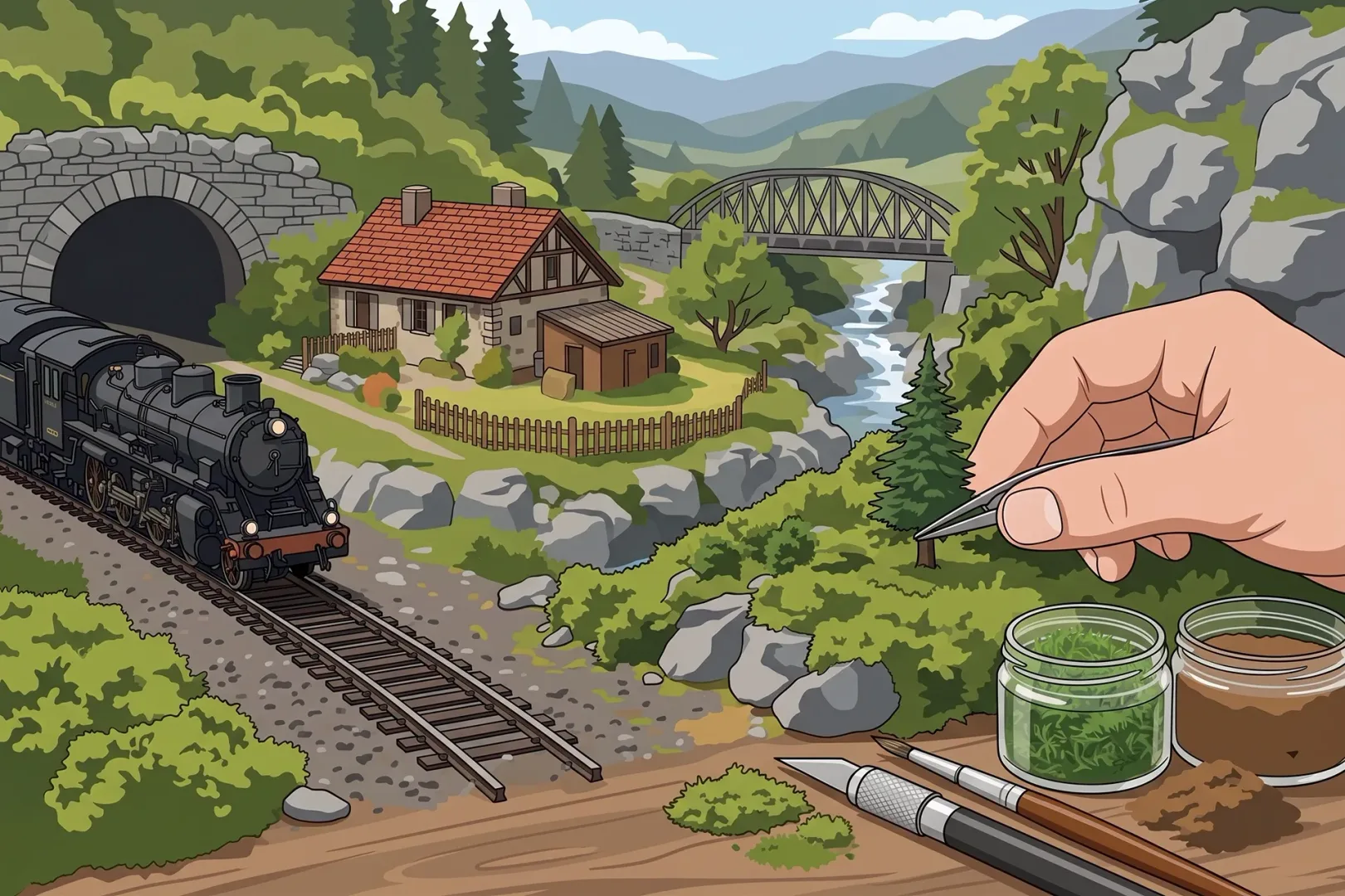
A convincing layout usually stops looking like a train set at the edges - where the grass meets the ballast, where the road meets the yard, and where the eye starts asking awkward questions. That is why the best model railway scenery tips are rarely about buying more materials. They are about making better decisions with scale, colour, texture and restraint.
Great scenery does not need to be expensive, and it certainly does not need to be finished in one big push. Most memorable layouts are built scene by scene, with each section given a clear purpose. If you want your railway to feel believable rather than merely decorated, these are the habits worth keeping.
Model railway scenery tips that improve realism fast
The quickest upgrade is usually to stop treating scenery as background. On a strong layout, the land explains the railway. An embankment shows why the line sits high. A cutting shows why the train disappears behind rock. A goods yard looks busy because the surrounding ground is worn, patched and practical.
Start by asking what your railway is passing through. Is it a rural branch with rough verges and untidy hedgerows, a dense urban district with retaining walls and back gardens, or an industrial scene with ash, weeds and stained concrete? Once that answer is clear, scenery choices become easier, because every texture and structure has a job to do.
Build the landforms before the details
Many layouts go wrong because detail is added to a flat board too soon. Scatter, bushes and figures cannot hide a landscape that has no shape. Even a modest branch line looks stronger with gentle undulations, ditches, raised road approaches or a shallow cutting.
You do not need alpine drama. In fact, subtle changes in height often look more realistic in smaller spaces. A few millimetres of rise between the track bed and a nearby field can make the railway feel properly engineered into the landscape. In OO and HO, exaggerated hills can easily shrink the scene rather than enlarge it. In N gauge, the opposite can happen - slightly stronger relief helps the eye read distance.
Keep transitions soft
Real landscapes rarely change in a hard line. Ballast feathers into ash, weeds creep into cinders, and grass near the track is often sparse, dry or trampled. One of the most useful model railway scenery tips is to spend as much time on transitions as on individual scenic areas.
If your ballast ends abruptly and the static grass begins like a carpet edge, the illusion breaks at once. Blend materials into each other. Add fine soil tones between the trackside and open ground. Let patches of bare earth show through. A scene becomes convincing when one texture borrows from the next.
Colour matters more than brand names
It is easy to get drawn into product comparisons, but colour choice usually makes a bigger difference than the label on the packet. Straight-from-the-bag green scatter can look harsh under layout lighting, and many scenic materials are brighter than anything seen trackside in the real world.
Muting your palette helps. Mix greens with straw tones, brown fibres and small areas of exposed earth. British scenery especially benefits from variation rather than saturation. Fields are not one green. Neither are embankments, especially near steam-era lines, diesel yards or neglected sidings.
Weather also shapes colour. A late summer layout should not have spring-fresh verges everywhere. A damp industrial district wants soot, staining and dark corners. Coastal scenes often need faded timber, pale grasses and wind-shaped growth. If the colours match the season and setting, viewers accept the scene more readily.
Think in layers, not patches
Natural scenery builds up in layers, and model scenery should too. Start with the base colour of the ground. Add earth textures, then shorter fibres, then longer grasses, then low weeds, then bushes and occasional taller growth. This creates depth even in a shallow scenic strip.
The same applies to built areas. A yard can begin with painted ground and fine dust, then gain oil marks, puddle tones, rubbish, pallets and vegetation pushing through neglected corners. The result feels lived in. Doing everything in one pass often produces a flat, uniform finish.
Trackside areas deserve special attention
The track is the star of the layout, so the scenery nearest to it has the most work to do. Strangely, this is also where many scenes become too neat. Real railways are maintained where necessary, not manicured throughout.
Ballast should suit the line. A main line with clean shoulders and a lightly used siding with ash, dirt and weed growth should not look identical. Sleeper ends should not vanish beneath oversized stone, and the ballast colour should support the era. Fresh grey granite can work on modern scenes, while older branch lines often benefit from dirtier, warmer tones.
Drainage is another overlooked detail. Water has to go somewhere. Adding shallow ditches, culverts or slight falls in the ground makes even simple scenery more believable. The railway starts to feel engineered rather than placed.
Use weeds with purpose
Weeds are effective because they suggest time, use and neglect, but they need context. A few tufts between sleepers on an active main line will usually look wrong. Around buffer stops, behind signal boxes, at fence lines and in little-used sidings, they can look spot on.
Less is often better. A single clump in the right place says more than a dozen identical tufts spread evenly across the board. Variety in height, colour and density makes the scene feel natural rather than planted.
Structures should belong to the scene
A beautifully built station or goods shed can still feel detached if the ground around it is too clean or too level. Buildings need to sit into the landscape with paths, stains, edging, clutter and signs of use. The area around a structure often matters as much as the structure itself.
A farm scene wants muddy gateways, uneven grass and wheel-worn tracks. A small town station might need fencing, coal dust, stacked parcels or cracked yard surfaces. Industrial buildings usually look better once the surrounding ground is darkened, weathered and slightly untidy.
This is where selective detail pays off. You do not need to fill every inch. One loading bank with good surface texture and a few well-placed details will usually beat a crowded yard full of items that all shout at once.
Backscenes and view control make a huge difference
If you have ever photographed your layout and found one angle looks brilliant while another exposes the room, the issue is not always the model. It is often view control. Backscenes, low relief buildings, hedges, bridges and tree lines all help guide the eye and hide the edge of the world.
A good backscene does not need to be elaborate. It simply needs to support the foreground in colour, horizon height and atmosphere. Gentle hills, distant rooftops or an industrial skyline can extend the scene without demanding attention. What matters is the join. If the foreground finishes with a sudden vertical break, the illusion weakens.
Compose scenes for how people actually look at them
Most visitors do not study a layout from directly above. They take in scenes from normal viewing height, then focus on small stories - a van at a warehouse, a couple on the platform, a wagon left in a weed-strewn siding. Thinking this way helps you compose stronger scenic moments.
Try to create short visual journeys. A road disappears behind a terrace. A footpath crosses a field towards a halt. A line curves into trees and emerges by a bridge. These moments encourage viewers to linger, and they photograph well too - useful if you plan to share your layout with the wider community on ModelRailwayLayouts.
Know when to stop
One of the hardest scenery skills is restraint. Every layout has a point where one more bush, one more sign or one more scenic gadget starts to weaken the whole. Real places contain open ground, plain surfaces and quiet corners. Your model should too.
If a scene feels busy, remove something before adding anything else. Give structures room. Let embankments breathe. Keep some areas simple so the best details have space to stand out. This is especially important on smaller layouts, where overcrowding can make the scale feel compressed.
Perfection is not the goal either. Small irregularities often help. A fence line that is not laser-straight, a patchy verge, or a slightly uneven lane can add character. What matters is whether the scene feels plausible.
The most satisfying layouts are rarely the ones with the most scenery. They are the ones where the scenery helps the railway tell a story. Build that story one section at a time, trust observation more than packaging, and let each scene earn its place.
Related Posts
Comments (0)
Community Guidelines
Keep all comments friendly. Feedback should be constructive and no derogatory comments are tolerated.
Sign in to join the conversation
No comments yet
Be the first to share your thoughts!